
-
Recent Posts
Archives
Categories
- Advertising Information
- Arts
- Bars
- Carlos Menchaca
- Coffey Park
- Community Board 6
- Community Organizations
- Cora Dance
- Crime
- Editorials
- Education
- Entertainment
- Estate Four
- Feature Story
- Fire Department
- Gowanus Canal
- Holidays
- Kimberly Gail Price
- Letters to the Editor
- LICH
- NYCHA
- Politics
- Real Estate
- Red Hook Houses
- Sandy Related
- Satire
- Spoof
- Theater
- Uncategorized
Hours & Info
1-718-624-5568we can be reached by email 24/7Meta
Local Links
A Star-Revue Facebook fan page
Red Hook is the place to be this 4th of July, by Peter Axtman
For the first time since 2009, Red Hook residents will have a prime view of Fourth of July fireworks. With the Macy’s annual fireworks show returning to its old East River location – at the behest of first-year mayor Bill de Blasio – Red Hook’s neighbors across the river will once again put on a fireworks display. de Blasio’s Jersey City counterpart, fellow first-year mayor, Steven Fulop, announced in May plans to re-instate what was once a New Jersey tradition.

The possibility of viewing fireworks from Red Hook has been met with a mix of excitement, optimism and confusion. While Brooklyn Greenway Initiative Co-Founder, and Red Hook resident, Brian McCormick lauded the benefit for the local business the fireworks would bring, some workers at local establishments were unaware that the midsummer show will be viewable within the neighborhood.
From a public greenway to rooftop dining, much has changed in Red Hook since the last Jersey City fireworks display. In anticipation of the holiday, the Star-Revue has canvassed the neighborhood to find the best places for celebrating the midsummer lights show.
Public Parks
Louis Valentino Jr. Park and Pier
One public place that many Red Hook residents agreed will have great views is Louis Valentino Jr. Park and Pier, located on Ferris St. between Coffey and Van Dyke Streets. The park and pier, home to neighborhood institution Steve’s Key Lime Pie, boasts the clearest views in the area of the Statue of Liberty, Governor’s Island and Liberty State Park. Given the open miles of viewing and free admission, the park and pier are likely to fill up quickly, putting seating areas at a premium.
Columbia St.
Brooklyn Greenway
The last time the fireworks were so clearly visible from Red Hook, the neighborhood did not have the free, public stretch of Greenway that will be available to viewers this year. Beginning on the west side of Van Brunt Street at the intersection with Imlay and Carroll Streets, the paved Greenway extends north to where Atlantic Ave meets Columbia Street (and beyond). McCormick welcomes the public to the Greenway but asks that spectators are considerate of foot, bike and car traffic.
Restaurants
Brooklyn Crab
For the Reed Street multi-purpose restaurant, bar and beer garden, the Fourth of July will be popular business as usual, with one added bonus. According to manager James Ferrarone, the restaurant will host a special Fourth of July shrimp boil near the front entrance among the Adirondack chairs.
The summer staple will otherwise continue regular operations. The rooftop dining room is surrounded by eight large windows that will be open, according to Ferrarone, providing near panoramic views of the city and the river. For residents looking seeking these prime tables, patrons will be seated on a first-come, first-serve basis as usual, Ferrarone says. Those hoping to take in the fireworks from the three-year-old restaurant should budget in extra time in case of long wait times.
Fairway
According to locals, the popular Fairway summer patio will be a prime spot for fireworks watchers. Fairway attendees should be able to see the fireworks, but a handful of trees to the patio’s west side could obstruct some views. The market is open daily until 10 p.m., but management was unavailable for comment on extended Fourth of July hours.
Alma
Thinking of trying to snag a table on Alma’s rooftop dining room? Unfortunately for the public, the restaurant will host a private party on the Fourth of July until close, making the neighborhood’s premier rooftop dining area off limits for the general public.
Manager Lourdes Leon offered a consolation prize to those disappointed that the roof will be unavailable. Alma’s second floor dining room, which Leon points out has very large windows, will be open. The restaurant will provide a special menu, which has not yet been determined, though Leon warns that there will likely be an hour wait time. Diners won’t be allowed to post up at the tables all night, so patrons will have to time their dinner just right to catch the fireworks through the windows.
Water Walkways
Directly south of the Fairway patio is the half-mile long publicly accessible walkway that will provide prime, unobstructed views toward Liberty State Park. About 10 feet wide, residents and fireworks watchers will likely claim their spots early in the day. The walkway begins at the south end of Conover Street and extends past Fairway and the Brooklyn Waterfront Artists Coalition building.
Other Options
Private Viewing Parties
Even with great, publicly accessible options for watching the patriotic celebration, a common theme among residents is that some of the best views are from privately owned or rented roofs, boats and piers. McCormick mentioned that he’s had people over to his roof in the past, but he much prefers to be among the crowds on the Greenway, which conducts a better energy, he says.
A few VFW members explained that they’ve watched the fireworks on friends’ boats or as guests of private companies in the Brooklyn Cruise Terminal or Red Hook Container Terminal.
For those lucky enough to live or know someone who lives in the apartments and condos above Fairway, the building’s adjacent parking lot will provide opportunities to set up seats amid the cars. Meanwhile, apartments with a western exposure should offer prime window views.
Off-limits to the public
In addition to the Alma rooftop, a number of places that would otherwise be prime viewing spots are cordoned off to the public. According to Terminal Manager Dave Esposito, the Brooklyn Cruise Terminal will not have public access because it is a secured facility.
Police Guidelines
According to a source in the 76th precinct, the police department will have officers throughout the neighborhood working details to ensure safety for all fireworks viewers. The department does not expect to close any streets and asks that revelers obey all laws and are considerate of traffic passing on the streets.
Posted in Holidays
2 Comments
Gowanus Gunman Shoots 2 Ironworkers, Kills Self, By Harrison Neuhaus
A gunman fired shots at a Gowanus iron shop earlier this morning, wounding two before barricading himself inside a building and killing himself. According to local police, a report of gunfire came in at around 11:20am. The suspect opened fire at C&A Iron Works on 13th Street and Hamilton Place after allegedly looking for a job there.

The shooting took place not far from Lowes
At approximately 11:17am the man, whose identity remains unknown, pulled a gun out of a black bag and fired several rounds, hitting two workers. One was shot in the torso, but the injuries of the other are unclear since witnesses were already on the run at that time. The victims were brought to Lutheran Medical Center, where one remains in critical condition, and the other stable.
Police quickly sealed off 13th street between Hamilton Place and Second Avenue, attempting to reach a peaceful solution to the standoff with the shooter. Emergency Service Units, Technical Assistance Response Units, and negotiators were all on the scene securing the area. Police cruisers, vans, ambulances, black Escalades, an armored truck, and a number of other emergency vehicles swarmed the streets. A number of officers patrolled the perimeter while others geared up in Kevlar vests and helmets. Even helicopters circled the industrial Gowanus neighborhood, sandwiched between Red Hook and the affluent Park Slope.
Reports of hostages filled the air with tension, heightened by rumors of a bomb threat that traveled among news crews and witnesses. Police ultimately relayed that the man had barricaded himself in an office alone: the shooter had holed himself up with a gun to his head before their arrival. Authorities also assured citizens that there was no bomb on the scene.
The man shot another worker before tossing a metal object with many wires outside the shop and running across the street to another building. Police brought in several bomb squad officers in full helmets and body armor to search the area. Checking car trunks from 13th street down to the Pathmark parking lot at the end of the block, no bomb was found. Police later disclosed that the object in question was just a lead pipe.

Policemen with bulletproof vests were sent to the scene.
Dzmitry Tabakin, 28, was working at C&A when the man entered this morning. Though he remains unidentified by the police, Tabakin alleges that he was a resident of Coney Island’s private Sea Gate community. Tabakin also claims that the gunman never even made it to the ironwork’s boss before he began shooting. Pulling the gun out of his bag, the shooter held it to a worker named Oscar and fired. At that point, the other ironworkers had to flee the scene.
Other witnesses were present on the scene, recounting the incident to members of the press. Several, including Dzmitry, were Ukrainian and needed translators to convey what they saw. Others are of Latino descent. According to one worker, the business works mainly on welding support beams for framing construction on buildings and houses. The workplace itself is typically very loud, and for this reason many did not immediately realize that bullets had been fired.
The incident supposedly began when a man entered the workshop, looking to speak to the manager about a job. Though he was directed to the management office upstairs, witnesses say he never actually made it to the office before he opened fire.
Though police had not yet made an official announcement regarding the incident, word soon got out that the suspect had taken his own life and was pronounced dead. Officers retained the perimeter around the street, allowing neither press nor citizens on the block.
While still awaiting an official briefing, one local man began asking the police whether or not the area was safe, and if he could return to work. Others continued about their daily business without interruption; several groups of individuals stepped simply passed by the police tape in the parking lot to go to shopping at Pathmark on Hamilton Place.
Information on the shooter’s identity and background has yet to be disclosed, and details regarding whether or not the man was actually denied employment remain unclear. What is certain is that the standoff is over, the victims are being treated, and police are thoroughly investigating the matter.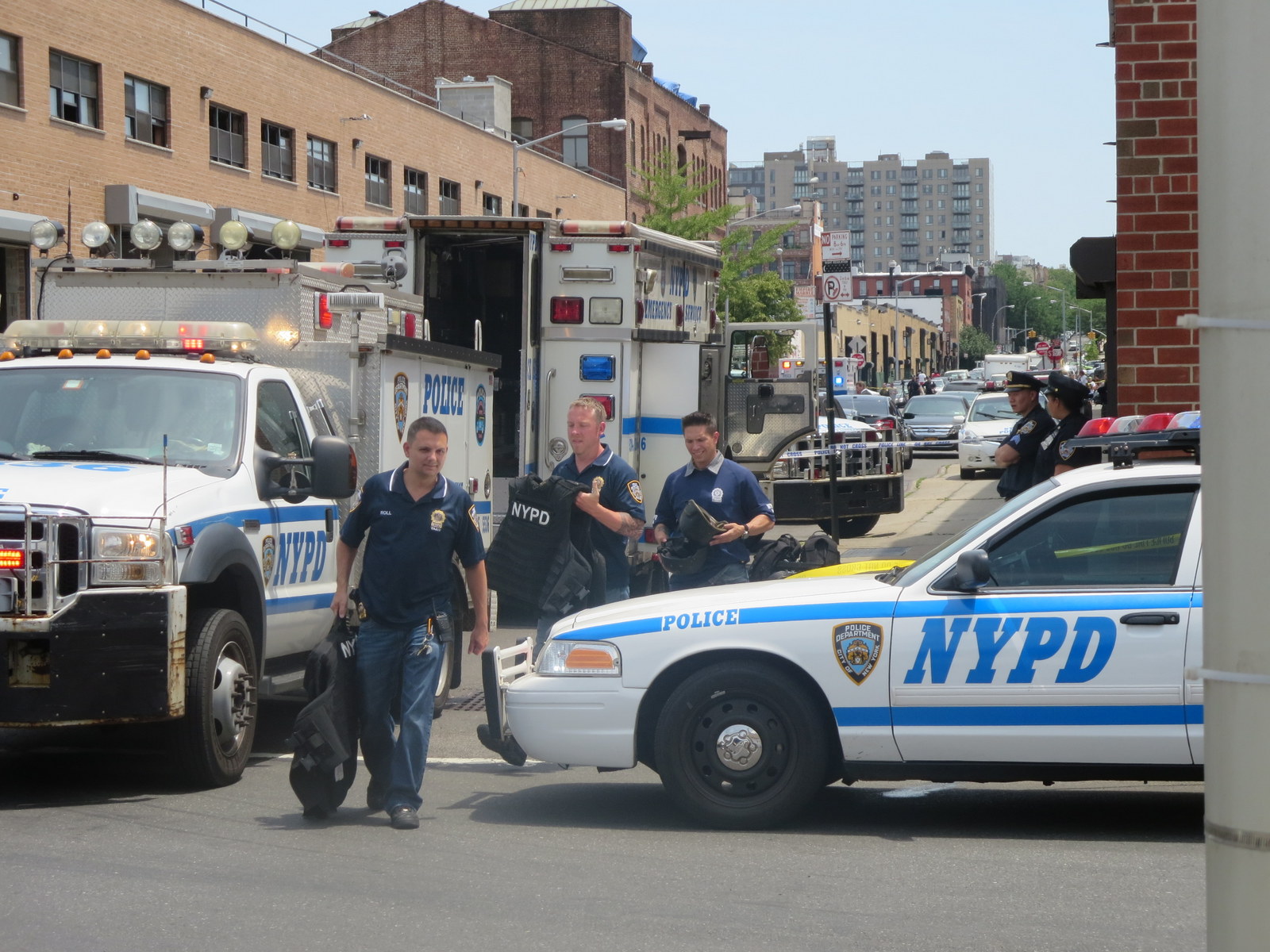


Posted in Crime
Leave a comment
Cross Country Fundraising begins on Court Street, by Clarissa Sauter
An event conceived in a Jerusalem pizza parlor three years ago made its way to Red Hook on Tuesday. Four cyclists who will bike across the country, raising money for children with special needs were given encouraging words, a Jewish Prayer book and American flag from last year’s trip at Investors Bank on 431 Court Street. A Senior Vice President of the bank, Marc Katz, was also presented with an award from Rabbi Bentzion Groner, founder of Friendship Circle International.

Investor’s Bank VP Marc Katz with son Noam
The bank is a major sponsor of Bike 4 Friendship, a 3,100 mile bike ride to raise funds for Friendship Circle, an organization that facilitates friendships between teen volunteers and children with special needs. Last year 17-year-old Noam Katz, son of Marc Katz, biked in the annual event and raised $18,000. The event raised $200,000 in total.
Their journey will begin July 6 in San Diego, with local supporters accompanying them for that portion of their trip. The cyclists will make pit stops at some of the 92 Friendship Circle centers in the U.S. for food and accommodations each night on their way to New York, where they’ll arrive seven weeks later.
Friendship Circle International is a humanitarian organization that pairs teenagers and special needs children to provide them with meaningful friendships, something not often discussed in conversations about the children’s lives. “We’re strictly about friendship,” said Rabbi Groner.
Bicyclist Yitzy Smith said that in preparation for the arduous journey he’s been staying hydrated, eating a good diet, and has logged over 300 miles.
“It’s a crazy experience, riding through time zones,” said Noam Katz, adding that the natural elements were what made the ride so difficult. The route crosses the one hundred and ten degree deserts of New Mexico, the swampy Mississippi river and the rough Appalachian mountains. That didn’t deter any of the bicyclists, though.
“I’m super excited,” said said cyclist Nissi Andrusier. He explained that, like many other bikers involved, his main motives in riding on the 85-mile-a-day route were to experience America’s diversity and fund Friendship Circle’s great cause.
To find more information about Bike 4 Learning and Friendship Circle, please visit http://www.bike4friendship.org/ or http://friendshipcircle.com/ .

Posted in Community Organizations
1 Comment
Editorial: Is change inevitable?
Our cover story this issue details the Red Hook plans of a real estate developer. They have big plans for the neighborhood, and many feel that this is a great thing for Red Hook.
The developer has bought some of our old industrial buildings and have grandiose plans to turn Red Hook into a regional artistic hub.

The old days of large scale manufacturing and repair is just about over in Red Hook.
In a time seemingly eons ago, a local developer was able to buy many properties along the waterfront – the old warehouses. He was wise enough to save and restore most of the buildings he purchased, and repurposed them for the new types of manufacturing that was slowly springing up – replacing the simpler, and larger scale manufactured that had already moved to China.
It was a different time, and while not everyone in Red Hook was completely pleased with the change, it was an evolutionary change that helped stabilize the community.
This new change might be a bit more revolutionary. We are told that when a property is zoned ‘as-of-right,’ as Esta4te Four’s acquisitions are, neither City Planning or the Board of Standard’s and Appeals need to be consulted. The new property can do whatever they like, as long as the existing zoning regulations are complied with.
Red Hook is a neighborhood containing a lot of people with a lot of opinions. As we have seen with the recent experiences of the BASIS school and a planned drug rehab clinic, the community likes to feel that they have some say in the future of the neighborhood, even when if by law they do not actually have any say. Right now, many people are upset about the lack of communication coming from the Parks Department as they redo Coffey Park.
Based upon the track record of Esta4te Four, it seems likely that the face of Red Hook will indeed change. Young urban professionals will be coming here to work, and perhaps to live, bringing lots of business to Van Brunt Street. Inevitably, what has happened to Smith Street and Bedford Avenue will start happening here.
Some of the mom and pop businesses will not be able to make the transition, as rents will no doubt head skyward. The sleepy little village that many of us really appreciate, will become a bit more like the higher end neighborhoods that surround us. Possibly even more so.
This is not good nor is it bad. It is the price of success.
There will be lots more things to do – places to eat – boutiques to shop in. Those of us that will stay will enjoy a happening neighborhood full of culture and modern people and better places to get a haircut, or rather a style.
There is only one red flag that we can see thus far. We would have thought that forward thinking developers looking to make a community theirs might want to reach out to the local paper.
The Star-Revue kind of found this all out by accident.
Posted in Editorials
1 Comment
Red Hook 2024, by Micah B. Rubin
If all goes according to plan, Red Hook’s “back” will be unrecognizable within ten years.
The Los Angeles-based developer Est4te Four has a reputation for breathing new life into abandoned and derelict buildings. They’ve turned gritty neighborhoods in Milan and London into centers of culture and fashion.

Hidden Places is a glossy magazine, complete with fashion advertising, that Estate Four created as a merchandising tool for their real estate sales.
Their current projects at 160 Imlay Street and 202 Coffey Street are set to transform Red Hook’s waterfront into an engine of creativity.
“We were attracted by [Red Hook’s] strong artistic atmosphere,” the developers say in an interview in Hidden Pl4ces, a glossy magazine created to promote the 160 Imlay project.
“Everything started because I discovered Red Hook through some friends. I felt it was a very undiscovered jewel,” says Aldo Andreoli, of AA Studio, the project’s architect. “It was so close to everything but distant in a certain way.”
Purchased in 2012 for $25 million, Est4te Four’s plans include converting the “underappreciated” and “underutilized” New York Dock Company building into a mix of commercial and residential spaces catering to artists and creatives.
The building’s previous owners struggled for 5 years before successfully receiving mixed-use rezoning approval in 2008, and Est4te Four is reaping the benefit of the past owner’s labor.

Artist rendering of 160 Imlay, which is already under renovation.
Seventy loft-style apartments – with ceilings ranging from 12-16-feet tall – are planned for the building’s 230,000 square feet, in addition to 6 commercial spaces: art studios, offices and a ground-floor café.
Andreoli minimized internal hallways and inserted 5 elevator cores, which allows for floor-through apartments with views of both Manhattan and Brooklyn on the building’s top 3 floors. The 6th floor, converted water-tower penthouse affords 360-degree views and a rooftop lounge. A garden is planned for building residents.
“I love the views, the location, the sense of space that is created by looking at the Bay of New York,” says Andreoli, who plans on moving into the building when construction is complete.
To project the building against possible flooding, all of the buildings mechanical systems are on the roof and the 2nd floor, Andreoli says. In addition, floodgates will be installed to protect the first floor spaces.
In addition to adding Highlinesque greenery to Imlay Street’s industrial character, the building’s street-level landscaping will double as a sponge during heavy rains or inundation through the use of salt-tolerant plants.
Apartments go on sale in July 2014 and will range in price from $650,000 to upwards of $5 million for a penthouse according to Patti Larroco, the Douglas Elliman broker handling the building’s sales.

The glossy magazine is full of fashion shots taken in their raw spaces.
A few blocks south of 160 Imlay is the 202 Coffey Street warehouse, just north of Valentino Park. The area has already seen a growth in development from stores like Steve’s Key Lime, Brooklyn Motor Works and Pier 44 Antiques.
Est4te Four also purchased 202 Coffey Street in 2012 for $11.8 million. The building dates back to the 1880s and served as a production warehouse for high-end purses as well a ship building parts company.
The red-painted brick building has ceilings up to 55-feet tall, exposed wooden trusses, exposed brick walls, oversized windows openings (that are currently bricked up, but will be reopened during renovation) and two courtyards.
The building in its current gritty condition has served as a location for a Vogue Italy fashion shoot and last month, Falconworks Artist Group, a neighborhood theater company, completed an 8-run performance of Romeo and Juliet in the space.
Plans for 202 Coffey Street are still under development, but Est4te Four’s vision includes converting the 130,000 square foot building into a “Global Hub for Art, Creativity, Fashion, Design and Events” the project architect, AA Studio’s website says.
In a 2012 interview with The Commercial Observer, Est4te Four’s head Alessandro Cajrati Crivelli said a photography school and artist studios would be features in the redeveloped space.

The magazine included articles about many Van Brunt Street merchants.
Est4te Four also owns the New York Daily News’s former printing press factories at 68 Ferris and according to the developer’s website, plans on converting the 790,000 square feet of waterfront buildings into a mixture of commercial and residential spaces – and possibly even a hotel.
These plans may sound ambitious, but Est4te Four’s reputation of successful projects – most notably Milan’s Zona Tortona make success all but assured.
Est4te Four transformed a derelict industrial zone in West Milan, Italy into a hub of international fashion with 3.5 million square feet of mixed-use space, which is now home to designers ranging from Armani to Zegna to Brioni, a hotel and the Museum Arnaldo Pomodoro.
They also turned Howlick Place, a former mail sorting facility in London’s Victoria neighborhood, into the epicenter of a growing “cultural quarter” that includes fashion designer Tom Ford’s world headquarters and the contemporary-art auction house Phillips European headquarters.

Fort Defiance received prominent notice.
“Through their expertise and connections [Est4te 4 is] able to bring people in the art and fashion business. There’s a movement of creative people that follows them,” Andreoli says.
Est4te Four’s first venture in New York began in Tribeca – creating a full-service film and photo studio for London’s Spring Studios. The studio has already excited the New York fashion community and designers like Michael Kors and Diane von Furstenberg hosted their Fashion Week runway shows at the fledgling studio.
As their Red Hook projects progress, Est4te Four is also working to improve the neighborhood’s accessibility on public transport by lobbying for a new water taxi station and creating a bike-share program (possibly securing the neighborhood a Citi Bike station) according to their self-produced promotional Hidd4n Places magazine.
Neighborhood engagement has been part of the developers plan. The Hidd4n Places magazine featured local artists and business owners like Pier Glass founder Mary Ellen Buxton and The Good Fork’s Ben Schneider.
“My experience with them has been a good one so far. I think they are trying to do something dynamic,” Schneider says. “I’ve always been in love with [the 202 Imlay and 160 Coffey Street buildings]. They’re just so beautiful, so the mere fact that they’re not getting torn down is a great thing,” he says.
And building the community is what Est4te Four has in mind. “We are not only here to try and make money, but have an interest in really making the neighborhood more interesting and livable,” Andreoli says.

Jeffrey Deitch is considering Red Hook for a new art venue.

Posted in Estate Four, Real Estate
3 Comments
It’s NYC vs. EPA at monthly CAG meeting, by George Fiala
From day one, NYC has been against the Gowanus Canal’s Superfund designation, finally granted in 2010. It was opposed not only by the Bloomberg administration, but also the local City Councilman at the time.

Emily Lloyd and Buddy Scotto (Carroll Gardens mayor), go way back.
The Daily News reported, in an April 2009 article, “City Councilman Bill de Blasio (D-Park Slope) said he didn’t believe the cash-strapped federal program would be able to come up with the funding to complete a cleanup. “We’re being sold a bill of goods,” he said. “There isn’t necessarily money attached. … How can you call it Superfund if there’s no fund?”
The fact is that the EPA investigates who the polluters were, and they, not the EPA, pays for the cleanup. In the case of the Gowanus, the main polluters were identified as National Grid (who inherited the designation from the old Brooklyn Union Gas/Keyspan, which they purchased in 2007), and the City itself.
At the June meeting of the Gowanus Community Advisory Group (CAG), EPA advocates met the city head on, as the NYC Department of Environmental Protection (DEP) head, Emily Lloyd, showed up to answer questions.
There was a bustle of excitement in the overpacked meeting room at St. Mary Star of the Sea senior citizen center, on First Street in Carroll Gardens. The turnout in recent months had been somewhat sparse, but this evening many made their way over, possibly expecting a sparring match between the city and federal agencies. Brad Lander and Steve Levin both stood in the back, and even Nydia Velazquez, on the night of the Congressional primary came, sat down in the front and contributed some salient comments.
The meeting began a bit late as the CAG facilitator, Doug Sarno, had to make his way from Grand Central Station. Jerry Armer, CAG member and old/new member of CB 6 began the meeting in his stead. Sarno showed up as Armer had everyone introduce themselves, and he acknowledged the presence of the invited guest and had her up to speak right away.

Lloyd knows the Gowanus very well.
Lloyd is a Brooklynite and is in her second tenure as DEP head. She served under Mayor Bloomberg from 2005 to 2008. Since 2010 she had been head of the Prospect Park Alliance and has also served with the Port Authority.
She broke the ice this evening by relating a story about the Gowanus Canal. In 1990, when her daughter was eight, she took her on a walk over the Gowanus. Her daughter came home and wrote a letter to President George HW Bush asking why he wouldn’t clean up the canal. Lloyd, fully aware of the City’s past position, went on to say that cleaning up the canal was something we all wanted.
A contentious point, and the main one discussed this evening, was the city’s role in sighting, designing and building two large containment structures that would hold sewer overflows during rainstorms. This was an important part of the EPA’s September 30th Record of Decision (ROD). EPA had determined that in addition to the huge amounts of toxic poisons on the bed and under the canal, waste sewage was and continues to be a major contaminant. Both the EPA and National Grid, responsible for dredging and capping the canal, thus removing most of its toxic underpinning, are insistent that the cleanup not be spoiled by the raw sewage that up until now is released into the canal whenever the nearby sewers overflow.
Concerned about the city dragging their feet on their Superfund obligations, EPA attorney Brian Carr sent the city a 16 page letter expressing their concerns. Dated May 27, the letter concluded,
“For the reasons described above, EPA believes that, despite some degree of progress, RD (remedial decision) negotiations have reached an impasse. We are concerned that continued negotiations will result in substantial delays in securing commitments for the RD, starting the actual RD work, and advancing to RA negotiations with all PRPs. At this time, we believe we have no choice but to consider our other enforcement options, which as you know, may include issuance of an order unilaterally for the City to perform the RD.”
On Monday June 23, the day before Lloyd’s appearance before the CAG, the city responded with their own 10 page legal response, ripping apart the EPA’s arguments, but concluding:
“The City intends to continue to cooperate with EPA in implementation of a remedial decision that is based on sound science, in compliance with CERCLA and the NCP and on a schedule that is feasible and consistent with City procurement and other rules.”
Both letters were circulated to CAG members before the meeting, with the proviso that these ominous sounding letters are quite normal in EPA negotiations with who they call Potentially Responsible Parties (PRPs), who are given the cleanup responsibilities.
In her introductory statement, Lloyd commented on the city’s position regarding the holding tanks. She said that work on both site location and the design of the tanks had already begun. At a CAG meeting earlier this year, EPA Project Manager Christos Tsiamis said that he wanted the city to pick a site by July 1st. Lloyd stated that they plan to have a site chosen by the end of September. The EPA had recommended placing the tanks under Double D Park, as the State has already designated the park for toxic remediation due to contamination under the city pool there. Tsiamis thought that common sense would dictate killing two birds with one stone. Many residents objected to having their pool closed at all. Commenting with this in mind, Lloyd said that “the challenge is to work with the community to arrive at a site causing minimum disruption.”

Nydia Velazquez marches in even though it’s Primary Night
The CAG audience was very polite, giving Lloyd every benefit of the doubt, and she herself seemed conciliatory. In the middle of this beginning, Congresswoman Velazquez, a prime mover of the Superfund, arrived. She wasted no time in getting to the point. Bringing up the city’s reticence under the Bloomberg administration regarding Superfund, she blasted the room with a strong statement.
“I expect better collaboration from the city this time around! I am optimistic that under this administration it will happen.”

Velazquez did not mince words. She is an ardent supporter of the Superfund
At this point, Councilmember Lander echoed those sentiments, at the same time pushing his Bridging Gowanus meetings, the final one taking place the next evening. “I look forward to being part of the community effort to figure out the best location for the tanks,” he said.
CAG member Diane Buxbaum asked the first question. She went right to the point as well. CAG members had been informed previously that in the case of non-cooperation by a PRP, the EPA would take on the work and then charge the PRP triple damages, which she brought up. Lloyd assured the group that the city would comply.
A further technical discussion ensued as to how exactly the city will pay for their share. Lloyd kept referring to the responsibility being the “rate-payers.” She meant that the city’s share of the cleanup money will actually come from the water bills. A DEP official in the room later clarified that DEP bonds would be issued as a way to raise the money.
Lloyd seemed very conciliatory during her hour long questioning, but did hedge at times. “In most cases we will be able to comply, but we want there to be some flexibility,” she said. “We might not be able to dot the I’s and cross the T’s – we might not be able to do everything.”
In discussing the city’s methodology in choosing a site for the container tanks, Lloyd stressed the importance of finding the greenest solution. Finding a location that works hydrologically, using gravity instead of pumps, would be important, she said.
Katia Kelly, who runs the blog “Pardon Me For Asking,” wondered why the city had to study each and every possible site, rather than just using common sense to pick out the best five or six. She, and the EPA, had assumed that the city would want to use land they already own, rather than purchasing land from a private owner. “A site could be bought,” responded Lloyd.
Lloyd answered each and every question respectfully and politely, and after she left the consensus was that a conversation was started. Members were hopeful, but still wary, not forgetting the city’s obstinence throughout the whole Superfund process up until now. A motion was passed to draft two letters – the first a letter of thanks for the Commissioner’s appearance, and a second reiterating the CAG’s concern that the city cooperate in a full and timely fashion.

Brad Lander is always for community involvement.
Oversight meeting uncovers mold and money shortages, by George Fiala
NYC Comptroller Scott Stringer brought his traveling Sandy Oversight show to the auditorium of PS 15 Tuesday evening.

The auditorium of PS 15 filled up by 7 pm.
Flanked by three of his deputies, by Councilman Carlos Menchaca and by the Mayor’s director of Housing Recovery, Amy Peterson, Stringer announced that he was in Red Hook to listen. This was not to be a normal feel-good town meeting Two lines were set up for people to tell their Sandy stories. Stringer vowed that everyone who spoke would get a follow up call the next morning. He said that for each person who wasn’t called, someone in his office would lose their job. Solutions would be found.
The biggest complaints of the night came from homeowners and businesses being overwhelmed by the lengthy Build-it-Back application process, and from NYCHA residents who are to this day suffering from mold and polluted air causing them various sicknesses including asthma.
Build-It-Back is NYC’s housing recovery program that was created to help distribute Federal relief funds. It has been severely criticized as thus far only ten houses are being worked on – out of thousands of applicants. It’s publicized failures prompted the Comptroller’s oversight campaign.

Monica Byrne tells her story – Vilma Heremia of the Carroll Garden’s Association waits her turn.
Monica Byrne was first in line to speak. She introduced herself as a founder of ReStore Red Hook. She called it the only organization that was 100% staffed by volunteers, giving grants totaling $600,000 to businesses such as hers. The grants were in the form of a series of checks mailed to 51 Red Hook businesses, helping them to stay open.
She spoke of a number of problems. First of all, SBA money were loans, and nobody wanted to take on more debt. Grant programs such as Build-It-Back required documentation of losses. She said that small businesses don’t always keep receipts of their purchases, and anyway, much paperwork was lost in the flood anyway. “The problem is in the application process,” she said. She also said that relief money should go directly to those that need it, not to programs. She did not name any specific programs.
Vilma Heremia, representing the Carroll Gardens Association (CGA), told of losses to the 106 low-income homes they manage in Red Hook. “We had to change boilers and do mold remediation,” she said. CGA had to spend $1.1 million to remediate the Sandy damage. They have been able to raise a half million from private sources, and is hoping that Build-It-Back would fund much of the rest, which has come from their operating accounts. “So far it’s been a big runaround,” she said.

Soot and mold are wrecking this NYCHA resident’s health.
Barbara, a resident of 80 Dwight Street, complained of black soot coming into her windows from the diesel powered temporary boilers that have been providing heat and hot water since the storm. “It’s making people sick,” she said.
Stringer interjected to say that the first audit his office took on was one of NYCHA, which is ongoing.
Another NYCHA resident, Carol Mass, explained that her daughter’s asthma has been getting worse and worse, she has to use a pump much of the time. She attributed it to the soot and to mold, but when NYCHA workers show up, they “do nothing.”

NYCHA residents from both Red Hook and Gowanus came to tell their stories.
The Fifth Avenue Committee sent a slew of representatives to speak. They had suggestions for Stringer, and also seemed to be requesting a partnership with Build-It-Back to facilitate the process. One of their suggestions was that the Build-It-Back contractors be taught resiliency planning as well as simple rebuilding.
Mary Kyle, from Van Brunt’s Dry Dock Wine and Spirits, found her element in the audience. She regaled them, saying that having to appear before Build-It-Back was like a trip to visit the great OZ – all smoke and no action. She almost broke into tears, saying that the alienation she feels from the city has been crippling. She was speaking both as a homeowner and business owner. “We need money – not cups of pudding!” was how she characterized the Sandy aid that she perceived since the storm.

Mary Kyle of Dry Dock has experienced many frustrations dealing with the Sandy help programs.
Stringer asked her what government organizations she was referring to, specifically. Mary thought a second and mentioned SBA, FEMA, her insurance company, Build-It-Back and Red Hook Rising. “I got bupkus!” she said.
A Red Hook resident who is restoring her 1899 family home also complained about the enormous amounts of paperwork she has had to wade through. She has been able to move forward, and complimented local community organizations – specifically Red Hook Initiative, the Red Hook Volunteers, Rebuilding Together and the Good Shepherd Services. They have been “out of this world,” she said to applause. She suggested that these people be put to do the rest of the work.
Adam Armstrong, who led a campaign against diesel pollution from the Cruise Terminal, said that he felt for the people in the Houses suffering from the temporary generators. He said that he needed to fill the gap between what his insurance company paid to repair damage to his two family house, and what he has had to spend. Thus far he has been unsuccessful at getting this money. He declined an SBA application because “it’s a loan.”

Kimberly Gail Price of the Red Hook Star-Revue declared that Red Hook is not a third world country and shouldn’t be treated as one.
Carlos Menchaca spoke close to the end of the long evening, recalling the storm and the government response. We needed to do better and we will is what he said. At the time of the storm he represented City Council Speaker Christine Quinn in Red Hook, and got a first-hand look at the situation. Now he runs the 38th District.
He announced some upcoming meetings – a June 25th meeting back at PS 15 with Build It Back and a Long-Term Recovery Plan meeting June 12th at the Miccio Center. He closed by saying that the most important way to get government working for the people is for the people to show up. “We need community voices to speak up,” he said.
The community did a pretty good job this evening in front of the Comptroller.

Two local dignitaries sit together, Buddy Scotto and John McGettrick

Carlos Menchaca reminds all that the strongest power comes from the community.

NY 1 interviews our man Menchaca.

Red Hook’s Bea Byrd sits on the NYCHA board and took in all the tales of woe.
Posted in Carlos Menchaca, NYCHA, Red Hook Houses, Sandy Related
Tagged Buddy Scotto, Carlos Menchaca, Scott Stringer
2 Comments
Daniel Cruz remembered in funeral service, by George Fiala
Daniel Cruz’s funeral service was held Monday night in the Rockaways, where he grew up. A loving crowd of about one hundred friends and family members filled the Mt. Carmel Baptist Church to celebrate Danny’s life of forty years.

Daniel Cruz’s last viewing, holding a Yankee baseball
Cruz was left on life support following an asthma attack on May 28th. He lived with his wife and three daughters at 16 Mill Street in the Red Hook Houses. He was feeding dinner to his children when he gasped for breath and told his wife, Tynisha Rogers-Cruz to call 911. By the time an ambulance showed up to take him to Methodist Hospital, his brain had died due to lack of oxygen. He was kept alive until May 30th, as he was a registered organ donor so in death he has saved others.
Danny was an ardent sports fan. Lying in state, he was wearing a Yankees hat and jersey, his hands clutching a baseball stamped with the Yankee logo.
Crystal Riddick read statements from cards the family had received, including one from Peggy Wyns-Madison, principal of Red Hook’s PS 15.
His sister-in-law, Latisha Rogers, read his obituary. It was a heartwarming statement of his life, and included “His family was everything to him and you would never see him without one or all of his daugthters’s by his side. He was not just their father but their constant companion, their protector and their world.”

Danny’s sister Marcy loved her brother
Sister Marcy spoke lovingly of her brother. She recalled their frequent car rides together. He loved driving, and loved Honda vans. Family photos were flashing throughout on two television screens on the back wall of the church, and one of them showed Cruz beaming behind the wheel of a silver Honda van. Marcy said that normally she wouldn’t be happy driving in an open car with her hair blowing all over, but with her brother that was just fine. She recalled one time when they sat by the side of the road with a flat tire. She said that her brother was too cheap to pay for Triple A, so they just waited for somebody to come by with a jack they could borrow. After a while he asked Marcy if maybe she could pray to speed up the process. All of a sudden, a man wearing white stopped and pulled out a gold jack from a case. Danny’s eyes lit up in amazement, and he looked at his sister and asked her to pray for a winning lottery ticket!
Marcy told about how she had lost the two leading men in her life in just three years. Their father, Danny Sr., passed away in 2011. Without breaking down, she explained how her brother Danny was her rock, made her feel safe, and would show up whenever she needed help with anything. “I was lucky to have those 40 years,” she said. “Danny was my younger brother – I was the luckiest sister in the world.”
She ended by telling her brother that she would see him “on the next road trip.”

Reverend Ferguson stands over all
Reverend Darren A. Ferguson opened and closed the ceremony. His closing was rousing, introducing religious themes with simple street talk that everyone could understand. Looking at Danny’s family, he spoke of his own loss. His wife had died at the age of 42, over ten years ago. Dying of cancer, she made him promise that he would remarry someday. He protested, but afterwards he realized that while she would never leave his heart, in her love she wanted him to move on. He did in fact sport a large gold band on his ring finger, so probably he has.
He told everyone in the room that a funeral is not a family reunion. In other words, it is everyone’s responsibility to be there for the Cruz family. Not that Mrs. Rogers-Cruz will not be able to bring up her daughters, but a man’s voice is also important.
A theme of the evening’s service was not the untimely loss of Danny Cruz, who had just turned 40, but the gift that God has given his family and friends by his life.

Councilman Carlos Menchaca greets Danny’s daughter Tea
Among the guests was local Councilman Carlos Menchaca, who greeted the family along with everyone else. After the ceremony he told the Star-Revue that an investigation into the circumstances involving the death is being undertaken by NYC Public Advocate, Letitia James, as well as lawyers hired by the family. He also expressed a continuing interest in starting a local volunteer ambulance service, an idea expressed at an emergency neighborhood meeting held last week.
Daniel Cruz was buried Tuesday morning, June 10th, at Cypress Hills Cemetery, baseball in hand.
Posted in Carlos Menchaca, Red Hook Houses
2 Comments
Emergency Meeting called in Red Hook, by George Fiala
People in Red Hook are slowly to understand that the closing of Long Island College Hospital is a disaster for Red Hook.

Captain Lenz and Carlos Menchaca leading the community discussion.
A tragic combination of news about a death that followed a half hour or more wait for an ambulance, plus an accident on Lorraine and Hicks that killed a 14 year-old-boy, led Wally Bazemore to call Felix Ortiz who called Carlos Menchaca who together called an emergency community meeting on Monday, June 1 at 5 pm.
So many community stakeholders showed up that the meeting had to be moved from a small room in the basement, across the hall to the cafeteria. Captain Lenz of the 76th precinct, along with other officers and Community Liaison Vincent Marrone were early arrivals. Other attendees included Robert Berrios, Henrietta Perkins, Francis Brown, who is the acting head of Red Hook East Tenants, her husband Hal, Victoria Hagman of Realty Collective, Mary from Dry Dock Wines and Spirit, Khadijah James and much of the Cruz family (it was Daniel Cruz Jr., who suffered the asthma attack and died before the hospital could help him), Wally Bazemore, John McGettrick, head of the Red Hook Civic Association, Cheryl Braxton, Kimberly Gail Price, Leroy Branch from Community Board 6, Karen Blondell, two from Menchaca’s office and Mitu Maruf representing Assemblyman Felix Ortiz, who was in Albany.

Looking toward the Hicks/Lorraine intersection where the fatal accident occurred.
The meeting began with a long discussion about traffic, prompted by the deadly accident earlier that day. Braxton pointed out that Lorraine Street has become much busier since IKEA opened up in 2006, but no stoplights had been added. Everyone agreed that Hicks and Lorraine has had more than their share of accidents. Captain Lenz explained what happened that morning.
At about 6:50 am, 14 year-old Nicholas Soto saw the bus arriving across the street. He ran into the street to try and catch it. This was across from the ballfield at the corner of Hicks and Lorraine. A BMW with Jersey plates, who Lenz explained was someone who was on his work to work, also saw the bus and moved a bit to the right side of his lane, without slowing down. He never saw Soto, and hit him going full speed. Soto was thrown onto the hood of the car and smashed the right side of the windshield. The BMW carried Soto across the intersection which is when he slammed on the brakes. Hitting the brakes caused Soto to fly off the car onto the ground. Police and ambulances showed up, but he was pronounced dead at the hospital. According to the Daily News, the driver, 28 year-old Juan Mancebo, of Elmwood Park NJ, was devastated and “sat on the curb for something like two hours, crying.”

The BMW after the accident.
Carlos asked for advice from the concerned gathering and promised to follow up all suggestions with DOT and other branches of government. Someone asked about school crossing guards, and Captain Lenz said in fact that they have openings for guards, and he might be able to put a new person on Lorraine once one got hired. Other complaints included frequent double parking – often by trucks, lack of stop lights and stop signs, and speeding cars. Someone suggested speed bumps, but it was explained that speed bumps are not put on roads that are part of an MTA bus route, nor are they put on two-way streets.
Another suggested having the city buses make some stops right near the houses, allowing school kids pick up the bus more safely. Mary from Dry Dock complained about 54 foot trucks and an accident on Van Brunt last month that the police haven’t prosecuted. Robert Berrios said that buses in New Jersey have decals on them that tell drivers to slow down when approaching.

Khadijah James holds up a photo of Daniel Cruz on life support at Methodist Hospital
After about 45 minutes, Khadijah James got up to speak eloquently about the death of her in-law. Daniel Cruz, Jr., suffered an asthma attack last week and died as his brain did not get oxygen for at least 40 minutes. The family is very upset, claiming that ambulances were very late showing up, and only showed up after they grabbed a police officer from the street. The officer gave CPR and used his radio to get help.
A long conversation follwed with people wondering how LICH could be allowed to close. It was pointed out that a LICH ambulance used to be stationed by Coffey Park, with drivers who knew the neighborhood. Finding an address in the Red Hook Houses can be confusing to someone who has never done it before. With LICH closing, ambulances from all over are being sent to answer Red Hook calls. In fact, one of the Cruz daughter’s suffered an anxiety attack that evening, right at the Miccio Center. Captain Lenz himself radioed for an ambulance. Finally one from Maimonides showed up, and the family says it was a half hour before she was delivered to the hospital, with is on 48th Street and Tenth Avenue in Brooklyn.
Additional topics included soil and air contamination in Red Hook, and the overgrown condition of Coffey Park, as it sits fenced off awaiting a promised renovation.

Wally Bazemore telling the crowd that the Ruiz family needs the support of the community, including at Christmas time.

Kimberly Gail Price speaks eloquently about the situation at LICH

Robert Berrios making a point.

The Cruz family occupied the first table at the Miccio lunchroom.

Captain Lenz reading a very good local newspaper.
 The Red Hook Star-Revue